
MEASURE YOUR BODY COMPOSITION
Our coaches teach high performance movements and habits to help teens & young adults learn to train, excel in sport, stay injury free, and grow into well-rounded adults .
- Measure your body composition, muscle mass, and fat mass in 3 minutes.
- No pinching or dunking with this reliable body composition test.
- Receive a printout of your results.
- Sit down with our coaches to discuss your results and a plan of action!
Try your first session FREE
One of our coaches will contact you within 24 hours
We focus on teaching movement for life. In these sessions, kids are taught movement patterns that are being missed in Physical Education programs. Kids learn to skip, run, sprint, jump, land, and throw. By building a strong foundation for movement, kids develop with a higher physical capacity.
Learn to move, move more, and move longer with these sessions, regardless of your age and potential limitations. If you want to keep doing what you love to do, join us. Choose from 35-min or 50-min sessions. We are changing the way Albertans age in a fun, safe, and engaging environment.
We write good emails. Join our mailing list.
900+ Subscribers & Growing
Coach's Corner
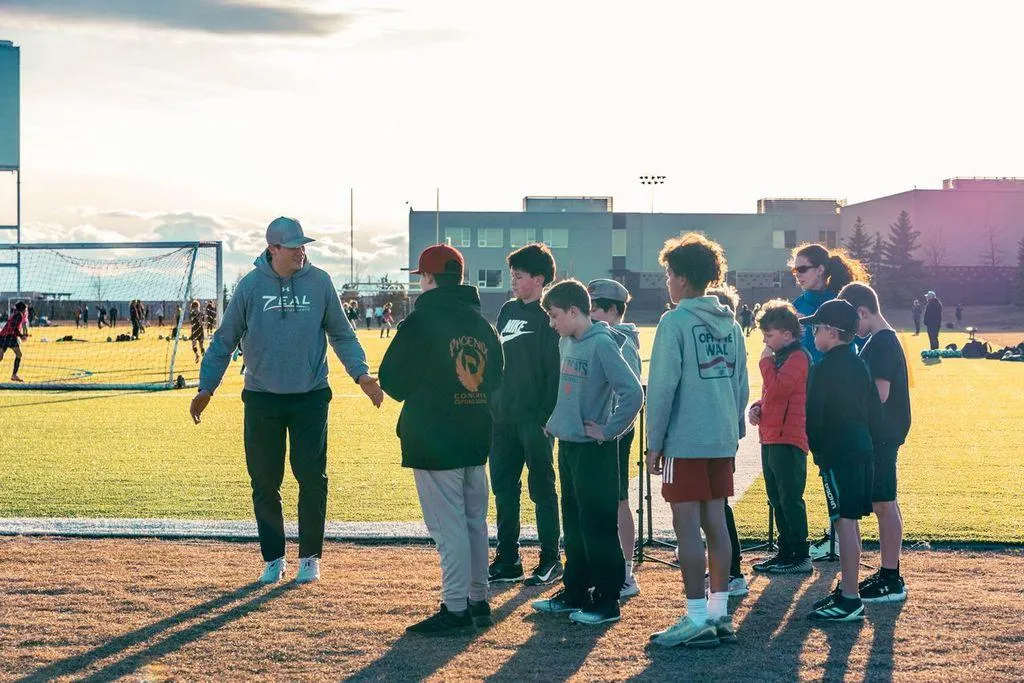
Strength and Conditioning for your kids

I know what you may be thinking, Strength and Conditioning for my kid?
That’s for those crazy sports parents!
Isn't weight training for kids bad, doesn't it stunt their growth?
The short answer to these misconceptions is NO - strength and conditioning will be an asset for your family...the long answer is below:
Here’s some of my arguments as a Strength and Conditioning coach, as well as a parent, on why you may be thinking about it in the wrong way. As a health and fitness professional I believe whole-heartedly that sports and fitness are a part of a well balanced life, ideally a well-balanced life that lasts until the day you pass. Creating a positive experience around movement and learning how to control our bodies plays an absolute critical role in how much we will enjoy physical activities as we age and mature throughout our lifetime.
This is so obvious to see when watching a group of teenagers perform a physical activity in a group (ie. high school phys-ed). Why do so many teenagers drop out of sport? In my opinion, as well as others I’ve spoken with over the years, if teens don’t feel comfortable performing an activity (sports, public speaking, etc.) they are much more likely to just opt out rather than put themselves out there and take a risk in front of their friends (FOPO - fear of other people opinions - is rampant in your teens). However, if we can give teens the confidence to solve movement problems (ie. new sports and activities) from a young age (ie. build a movement foundation) at least they will have the confidence in controlling their bodies. Granted this may not solve the social factors involved with FOPO but at least it is a start. Movement efficiency matters, having a solid foundation for movement matters, and having the confidence in oneself to solve movement problems matters! And unfortunately, in my experience the tool-boxes are not being built enough at early ages for kids…
Data in Canada is showing that more and more kids are getting the majority of their physical activity through organized sport: link here. While the reasons for this may be multi-factorial (schools providing less opportunity for physical activity, parents having less time or desire to get out and be more active with their kids, larger pressure to have kids be “good” at sports early on, business of sport pushing for profit, etc.), the fact remains that organized sport is the main vein of physical activity in youth. From my vantage point as a Strength and Conditioning coach (one that seeks to help athletes succeed in their sport of choice) this is an issue for the main reason that: sports coaches at the youth level are usually concerned with helping the kids at those levels improve the technical skills of that sport (hopefully this and not just winning), and while this isn’t a problem in itself, it can become a problem when that sport begins to become the only activity that kids do (we’ve all heard the horror stories of 6 year olds having their sport 5-6 days per week).
One sport = limited movement patterns and potentially chronic over-use injuries in youth athletes.
The availability of year-round options for sport development combined with the pressure for parents to keep their child involved in that one sport to keep them at the top or get them to the top of the food chain is a major issue. This pressure to perform and develop as a (insert sport here) player means less and less focus and attention on healthy physical development (never mind the social and emotional aspect) - it is all about performance and at way too young of an age. Being the best 8 year old in your sport doesn’t matter! Sadly this issue won’t get better and won’t go away because where there is competition, there will always be someone trying to get an edge. It comes down to a developmental philosophy of YOU the parent, what are you really trying to achieve with your kids; Long term success and development, or short term results (ie. winning) and sacrificed overall development?
Sports don’t focus on foundational movement - they focus on foundational skills!
Every sport has their foundational skills: Basketball has dribbling, passing, shooting. Hockey: skating, puck handling, passing, shooting. You get the idea…
The foundation from a physical standpoint can easily get overlooked by any sport coach. Especially when the majority of the coaches delivering the coaching are volunteer parents that have a limited understanding of the body and how it should move - they are generally trying their best to keep their heads above water with practice plans and keeping 20 kids engaged for a full 60-90 minute practice. The most foundational skill that every single athlete and (person) needs to master is how to control their body in time and space! This is what professional strength and conditioning coaches specialize in - controlling your body in time and space (especially when they are working with youth athletes).
How can we counteract this problem?
This is also where a professional strength and conditioning coach can help
A professional strength and conditioning coach can help guide young human beings to master their bodies and control their movements. Taking the competition out of movement can have huge benefits - this is why my kids were in gymnastics every week from a young age - the non-competitive gymnastics, which unfortunately has less opportunities to remain non-competitive and exploratory past the age of 8 it seems (which is why they no longer are in it). A professional strength and conditioning coach (who understands the end goal as well as growth and development patterns and skill development) can provide appropriate progressions and will understand when to challenge the athletes they are working with. They will also understand how to build balance around joints and movements that may be somewhat unbalanced due to the repetitive movements they are subjected to in their sport practices and games. Most of all they will make it their goal to teach an athlete how to gain confidence and ownership in their physical abilities.
Sports often value winning way too early - Environment matters!
The Norwegian sports association doesn’t even allow ranking of kids before the age of 12 (they have something called the Children’s Rights in Sport), and it hasn’t seemed to hurt their performance in sports at the highest level (they are currently the top ranked elite performance nation in the world (per capita), according to https://projectplay.org/world-sport-systems/ .
Competitive environments often aren’t conducive to skill development, when competition is introduced too early kids will cut corners in order to win. I’m not saying to never compete at a young age - but there has to be enough time given to strictly developing the skills they need. While I whole-heartedly believe that competitiveness is a key aspect in determining who will become elite in sport. I also believe that there needs to be a healthy balance of developing the skills to compete at the top level prior to introducing competition into it. Again, understanding how to control your body in time and space is an absolutely critical fundamental skill. When winning is the focus, there becomes less focus on the struggle that learning a new skill brings.
Different kids learn at different rates, sometimes they need extra help
As with any skill in life, some people need more time, feedback, and effort in order to master a certain skill. This extra exposure means sometimes the groups need to be smaller - the feedback more specific and individualized, and the tasks more targeted to simple movements. This is the place where a professional coach with an understanding of skill development as well as an understanding of the end goal is key and where a professional strength and conditioning coach can be an incredible asset. If I get an athlete who understands how to control their body in time and space (because they’ve had the opportunity to experiment and play around with their body) my job becomes incredibly easy. Vice versa, when I see an athlete who has limited movement patterns and limited range of motion at the age of 16 and up, my job becomes way more difficult and I have to spend so much more time working on rebuilding their foundation, and less time on optimizing their performance for their sport.
This is the reason why we have a youth program at Zeal Performance, it's also the reason we work with schools on our after school athletes program, - not because we believe 10 year olds should be dominating in their sport. Rather, we believe that with a solid movement foundation kids can dominate their own beliefs in themselves and their abilities to control their bodies in time and space. This will lead to so many benefits both physically, emotionally and socially, not to mention the benefits that will occur in their sport of choice…if they choose to pursue it.

Plan for about 15 minutes total, 2-3 minutes for the scan and the remaining time for any questions you may have.
Watch the video on how to get to Zeal Performance. We highly recommend you watch the entire video if you've never been to the Springborough Professional Center.
Address:
30 Springborough Blvd SW
Unit 208
Rules for testing:
(1) Do not eat or drink prior to the test. If you are testing before a workout, bring a snack for after your test. If you have to have a coffee before this test, make sure to have a coffee before your next test -- we want to test and re-test in consistent conditions.
(2) Use the washroom prior to your test.
(3) Wear tight fitting clothes with minimal metal (zippers, belts, buckles)
(4) Take off jewelry prior to testing
(5) Do not take the test if you are pregnant or have a pacemaker. If you are currently menstruating, your test results may be slightly less accurate due to fluctuating water weight.
(6) Do not exercise prior to taking the test.