
MEASURE YOUR BODY COMPOSITION
Our coaches teach high performance movements and habits to help teens & young adults learn to train, excel in sport, stay injury free, and grow into well-rounded adults .
- Measure your body composition, muscle mass, and fat mass in 3 minutes.
- No pinching or dunking with this reliable body composition test.
- Receive a printout of your results.
- Sit down with our coaches to discuss your results and a plan of action!
Try your first session FREE
One of our coaches will contact you within 24 hours
We focus on teaching movement for life. In these sessions, kids are taught movement patterns that are being missed in Physical Education programs. Kids learn to skip, run, sprint, jump, land, and throw. By building a strong foundation for movement, kids develop with a higher physical capacity.
Learn to move, move more, and move longer with these sessions, regardless of your age and potential limitations. If you want to keep doing what you love to do, join us. Choose from 35-min or 50-min sessions. We are changing the way Albertans age in a fun, safe, and engaging environment.
We write good emails. Join our mailing list.
900+ Subscribers & Growing
Coach's Corner
Development Models and what you may be getting wrong…
Take a look at the development model below - I think most people would look at this and it would make perfect sense to them that these are the main areas that have skills within them that you can work at to improve as an athlete.

The problem that this model represents in my opinion is that it is showing each pillar being separate and equal. And while it may help to highlight the different areas that you can develop, it doesn’t properly represent the fact that certain pillars will affect the overall development of athletes more than others.
For instance, I would argue that improving within the physical realm (ie. getting stronger, faster, more explosive, and more fit) will cause a direct and immediate improvement (or at least an opportunity to improve) in each other pillar. A stronger, faster, more fit version of your current self will; Have more self confidence (mental), Be able to apply that power and speed to your technical skills - thereby making them better, Be able to approach competition with different or expanded tactics or simply be able to practice more effectively for longer (theoretically improving tactics), Decision making will improve (due to more time and space, and less fatigue), And lastly, working on your physical self usually comes with improvements in other lifestyle components like sleep and nutrition.
I may be biased, but I don’t believe there is one pillar that innately causes an improvement in all the others as directly as the physical pillar. I’m not saying it is the most important, as I do believe the Lifestyle and Mental components are very important and also impact the others as well, but not as directly.
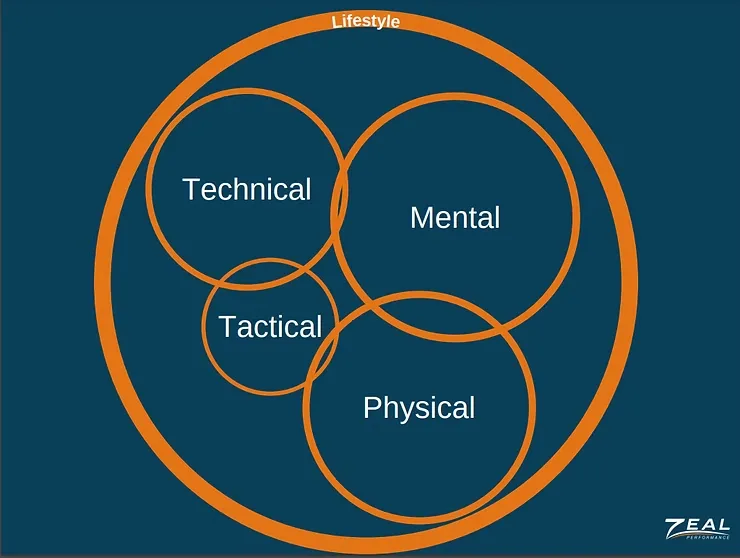
This brings me to a model that I typically will present to the athletes or programs that I work with here:

This model, I feel, does a better job of showing the relationship between the different spheres. First off, you cannot and should not separate the spheres, they develop alongside each other and are intertwined. As I mentioned above, a stronger version of you will have more available strength to apply in each other area. Secondly, I believe that a solid lifestyle that envelops all areas of development will help support the development of each other sphere (it doesn’t necessarily make them better automatically, but it will help support them). Third, I believe it makes sense to represent the spheres having different sizes as they have different levels of impact on the overall development of an athlete. Granted there are arguments to be had as to the size of each sphere, depending on the level of sport we are discussing (10 year olds vs 18 year olds for instance), or the sport itself (golf vs football for instance). But overall I feel this is a better model for how we can approach the development of the athletes…
That said, a lot of organizations are approaching development in a very different way. I’ve tried to represent that with the following model:
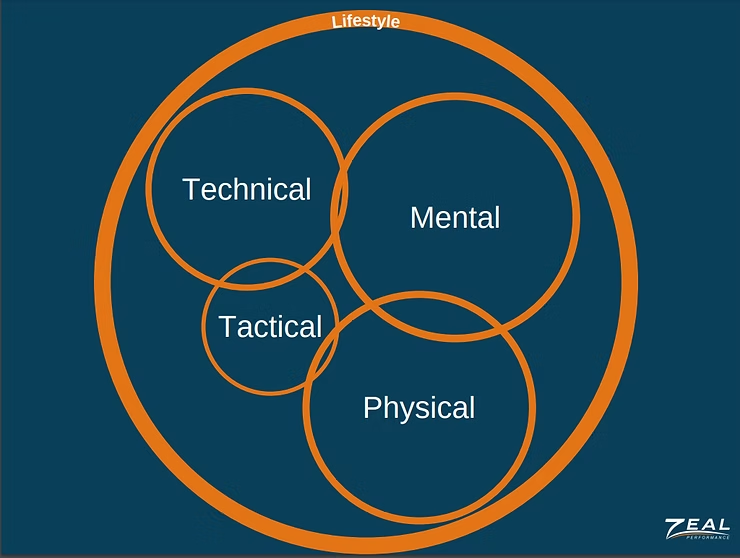
They may understand the different spheres, but they approach the development of them in a separated fashion with hours dedicated to each being way off (again, in my opinion). This segregated approach to development ends up in timetables for development that are unreasonable and the lack of integration on each sphere is inefficient. There are practices that focus on either technical skills, or team/sport tactics. Teams will have sessions designed to improve the physical - but it is maybe 1 hour per week, with no real follow up on it, in fact the coaches themselves often don’t attend. Maybe the teams and organizations talk about the importance of mental health, but the development of the athlete’s mental game is approached by hiring a sport psych to come in once a month (maybe to do a talk to the team) and at the next practice the coaches go right back to the same behaviors that contradict the best way to actually develop mental toughness. And lastly, there is very poor attention to setting up a lifestyle that is conducive to development. Teams and parents book extra practices and team functions that end up taking over the life of a young developing athlete and thereby giving them less and less time to be kids and god forbid actually take the time to rest and grow. Development comes from the growth and response to the stimuli of practices, games and training. But if there is no time between each event to reflect and grow, the growth never happens.
The results of these poor development plans result in all kinds of negative outcomes…chronic injuries, lack of motivation, less fun, negative view of sport in general...all which lead to drop out.
These are my opinions based on my experience in sport development over the past 15 years as a coach. If you talk to enough people that know what they are talking about, I think that most of them would agree. But please, argue with me - I’m open to a good discussion.
Thanks for taking the time to read, and if you know somebody who may be interested in reading this please send it along to them!
Doug and the Zeal Sports Performance team

Plan for about 15 minutes total, 2-3 minutes for the scan and the remaining time for any questions you may have.
Watch the video on how to get to Zeal Performance. We highly recommend you watch the entire video if you've never been to the Springborough Professional Center.
Address:
30 Springborough Blvd SW
Unit 208
Rules for testing:
(1) Do not eat or drink prior to the test. If you are testing before a workout, bring a snack for after your test. If you have to have a coffee before this test, make sure to have a coffee before your next test -- we want to test and re-test in consistent conditions.
(2) Use the washroom prior to your test.
(3) Wear tight fitting clothes with minimal metal (zippers, belts, buckles)
(4) Take off jewelry prior to testing
(5) Do not take the test if you are pregnant or have a pacemaker. If you are currently menstruating, your test results may be slightly less accurate due to fluctuating water weight.
(6) Do not exercise prior to taking the test.